Kenapa Berita Palsu Sering Menyebar Lebih Cepat daripada Klarifikasi?

Sebuah pesan masuk ke group chat.
Judulnya:
“VIRAL! Pemerintah Resmi Melarang…”
Di bawahnya ada screenshot.
Tidak ada link.
Tidak jelas medianya.
Tanggal juga tidak terlihat.
Tetapi karena judulnya mengejutkan:
langsung forward.
Lima menit kemudian sudah masuk ke group keluarga.
Sepuluh menit kemudian:
masuk Facebook.
Satu jam kemudian:
ribuan orang membagikan.
Kemudian muncul klarifikasi:
informasinya tidak benar.
Masalahnya?
Klarifikasi tersebut sering tidak menyebar secepat berita awal.
Kenapa?
Karena misinformation memiliki satu keuntungan besar:
ia sering dirancang agar menarik perhatian.
Berita Palsu Tidak Harus Terlihat Palsu
Kalau hoax selalu terlihat seperti:
font jelek,
website aneh,
dan kalimat kacau,
masalahnya akan jauh lebih mudah.
Sekarang informasi palsu bisa dibuat sangat meyakinkan.
Logo media.
Screenshot.
Video.
Voice note.
Grafik.
Bahkan foto yang terlihat realistis.
Packaging-nya profesional.
Isinya belum tentu benar.
Masalah Utamanya Bukan Hanya Bohong
Ada beberapa jenis masalah informasi.
Misinformation:
informasi salah yang dibagikan tanpa intention menipu.
Disinformation:
informasi salah yang sengaja dibuat untuk menyesatkan.
Malinformation:
informasi asli yang digunakan di luar context untuk menciptakan harm.
Dalam penggunaan sehari-hari, semuanya sering disebut:
hoax.
Tetapi mekanismenya bisa berbeda.
Orang Baik Bisa Ikut Menyebarkan Hoax
Ini penting.
Tidak semua orang yang share informasi salah punya niat buruk.
Sering justru karena:
ingin membantu.
“Sebarkan supaya semua tahu.”
“Kasih tahu keluarga.”
“Takut kalau kejadian.”
Good intention tidak menjamin information quality.
Emosi Mempercepat Share
Informasi yang membuat kita:
marah,
takut,
terkejut,
atau sangat senang
lebih mudah membuat kita bereaksi cepat.
Saat emotion tinggi:
verification sering turun.
Kita ingin:
share dulu.
Pikir belakangan.
Judul Sensasional Memanfaatkan Ini
Contoh:
“ANDA HARUS TAHU SEBELUM TERLAMBAT!”
atau:
“MEDIA TIDAK AKAN MEMBERITAHU ANDA INI!”
Bahasa tersebut tidak memberikan evidence.
Ia memberikan urgency.
Urgency membuat kita merasa:
tidak punya waktu untuk cek.
cara membedakan berita hoax dan fakta
Salah satu cara membedakan berita hoax dan fakta adalah dengan tidak menilai informasi hanya dari seberapa meyakinkan judul atau tampilannya. Periksa sumber asli, tanggal publikasi, konteks foto atau video, apakah media terpercaya lain melaporkan hal yang sama, dan apakah klaim utama didukung data atau dokumen yang bisa diverifikasi.
Jadi pertanyaan pertama bukan:
“Apakah ini terdengar masuk akal?”
Tetapi:
“Bukti aslinya apa?”
Familiarity Bisa Membuat Informasi Terasa Benar
Kita melihat claim yang sama:
di WhatsApp.
Facebook.
TikTok.
X.
Kemudian berpikir:
“Berarti benar dong, banyak yang bilang.”
Padahal semua bisa berasal dari:
satu source awal.
Repetition menciptakan familiarity.
Familiarity bisa terasa seperti truth.
Viral Tidak Sama dengan Terverifikasi
Satu posting:
2 juta views.
300 ribu likes.
100 ribu shares.
Itu menunjukkan:
attention.
Bukan accuracy.
Popularity tidak otomatis mengubah informasi salah menjadi benar.
Banyak Akun Bisa Mengulang Satu Kesalahan
Akun A salah.
Akun B copy.
Akun C screenshot B.
Akun D membuat video dari screenshot C.
Sekarang terlihat seperti ada:
empat source.
Padahal origin:
satu.
Ini alasan tracing source penting.
cara cek kebenaran berita
Dalam cara cek kebenaran berita, langkah paling berguna adalah mencari sumber pertama dari klaim tersebut, lalu membandingkannya dengan sumber independen lain. Jika berita menyebut pernyataan pemerintah, cari pengumuman resminya. Jika menyebut penelitian, cari studi atau institusi yang dimaksud. Jika menggunakan foto atau video, cek kapan dan di mana visual itu pertama kali muncul.
Verification berarti:
mundur ke sumber.
Bukan menambah forward.
Screenshot Bukan Sumber
Ini salah satu rule paling sederhana.
Ada screenshot headline.
Pertanyaan:
mana artikelnya?
Kalau hanya image tanpa URL:
kita tidak tahu apakah:
headline diedit,
artikel lama,
website palsu,
atau bahkan fabricated.
Screenshot mudah dibuat.
Logo Media Juga Bisa Dipalsukan
Ambil logo.
Masukkan ke template.
Tulis headline.
Sekarang terlihat seperti breaking news.
Karena itu brand appearance tidak cukup.
Check actual domain atau account verified/official.
Domain Mirip Bisa Menipu
Misalnya media asli:
beritaexample.com
Website palsu:
berita-example.co
Sekilas mirip.
Phishing dan fake news site sering menggunakan:
typosquatting.
Satu karakter berbeda.
Look carefully.
HTTPS Bukan Bukti Berita Benar
Ada icon gembok.
User:
“Berarti website aman dan valid.”
HTTPS hanya berarti connection encrypted dengan certificate tertentu.
Website scam juga bisa punya HTTPS.
Security connection ≠ truthfulness content.
Periksa About Page
Siapa publisher?
Ada editorial team?
Alamat?
Contact?
Ownership?
Tidak semua blog tanpa address otomatis hoax.
Tetapi transparency membantu menilai credibility.
Check Author
Nama penulis ada?
Apakah punya track record?
Apakah article anonymous?
Untuk breaking news, anonymous article masih mungkin legitimate dalam editorial system.
Tetapi author information bisa memberi context.
Tanggal Adalah Hal yang Sering Dilupakan
Berita 2018.
Dibagikan lagi 2026.
Caption:
“Baru terjadi pagi ini!”
Orang panik.
Article aslinya benar.
Context barunya salah.
Itu bukan fake article.
Tetapi sharing-nya misleading.
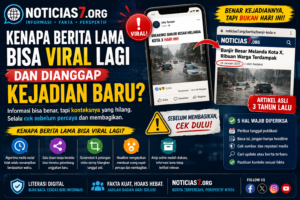
Old News Bisa Kembali Viral Saat Event Mirip Terjadi
Banjir lama.
Gempa lama.
Kerusuhan lama.
Video terlihat relevant.
Caption diganti.
Karena visualnya dramatic:
orang percaya.
Always check timestamp.
Foto Bisa Benar tapi Salah Lokasi
Foto kebakaran di negara A.
Diklaim kejadian di kota B.
Image itself authentic.
Claim false.
Ini salah satu bentuk misinformation paling umum.
Reverse Image Search Membantu
Kalau foto mencurigakan:
gunakan image search/reverse search.
Cari version lama.
Lihat website yang pertama memakai.
Kadang dalam beberapa detik terlihat:
foto sebenarnya dari 2019.
Metadata Tidak Selalu Tersedia
Orang sering bilang:
“cek metadata EXIF.”
Useful jika ada.
Tetapi social media sering menghapus metadata.
Screenshot juga kehilangan original metadata.
Jadi jangan bergantung pada EXIF sebagai satu-satunya verification.
Video Lebih Sulit
Video memiliki audio.
Movement.
Terlihat lebih credible.
Tetapi bisa:
old footage,
mis-captioned,
edited,
deepfake,
atau clip yang dipotong.
Video bukan proof final.
Context Sebelum dan Sesudah Sangat Penting
Clip 12 detik.
Seseorang terlihat marah.
Caption:
“Tokoh X menghina Y.”
Full video:
ternyata sedang quote orang lain.
Short clips dapat mengubah meaning secara dramatis.
Cari full version.
Deepfake Membuat Tantangan Baru
AI memungkinkan:
wajah,
suara,
video,
dan image
dibuat semakin realistis.
Dulu kita mencari:
jari aneh,
wajah glitch,
lighting salah.
Teknologi membaik.
Visual inspection saja semakin tidak cukup.
“Kelihatan AI” Juga Tidak Bisa Jadi Verdict
Foto asli bisa terlihat aneh.
AI image bisa terlihat sangat real.
Jangan berkata:
“Kayaknya AI.”
Tanpa evidence lain.
Source verification lebih reliable daripada feeling visual.
Audio Cloning Juga Meningkat
Voice note:
suara mirip public figure.
Orang langsung percaya.
Padahal voice cloning sekarang jauh lebih accessible.
Untuk claim penting:
cari official source atau video full context.
Breaking News Paling Rentan Salah
Saat kejadian baru berlangsung:
information incomplete.
Reporter masih mengumpulkan data.
Witness berbeda cerita.
Authority belum confirm.
Early reports sering berubah.
Itu normal.
“Belum Terkonfirmasi” Bukan Sama dengan “Salah”
Ada tiga state:
benar.
salah.
belum tahu.
Internet sering hanya memberi dua pilihan:
percaya atau bohong.
Padahal uncertainty sangat normal.
Belajar Nyaman dengan “Belum Tahu”
Ada incident.
Data belum cukup.
Response paling rational:
tunggu.
Tidak perlu punya opinion 30 detik setelah event.
Speed bukan selalu quality.
Klarifikasi Memang Lebih Membosankan
Hoax:
“BREAKING!!!”
Klarifikasi:
“Setelah dilakukan pemeriksaan terhadap sejumlah sumber…”
Which one gets clicks?
Emotional content punya advantage.
Truth sering membutuhkan explanation panjang.
Correction Juga Menghadapi Masalah Psychology
Orang sudah terlanjur share.
Identity ikut terlibat.
Kalau ternyata salah:
harus admit mistake.
Tidak nyaman.
Sebagian orang lebih memilih mempertahankan claim daripada mengakui error.
Confirmation Bias Memperkuat Hoax
Kalau berita mendukung belief kita:
standar bukti turun.
Kalau berita menyerang belief kita:
standar bukti naik.
Ini sangat manusiawi.
Makanya verification harus dilakukan terutama saat kita:
ingin sekali berita itu benar.
Berita yang Menyenangkan Juga Bisa Hoax
Tidak hanya berita menakutkan.
Contoh:
“Semua hutang akan dihapus!”
“Produk ini gratis untuk semua!”
“Tokoh ini resmi ditangkap!”
Kalau informasi membuat kita excited:
cek juga.
Desire membuat kita mudah percaya.
Political Hoax Sangat Efektif karena Identity
Saat informasi menyentuh:
group,
party,
candidate,
religion,
nationality,
identity,
reaction menjadi lebih emosional.
Information processing berubah menjadi:
defending team.
Karena itu political misinformation sangat sticky.
Jangan Gunakan Standar Berbeda untuk “Kubu Kita”
Kalau pihak lain salah:
minta correction.
Kalau pihak sendiri salah:
“Ya cuma typo.”
Double standard menghancurkan credibility.
Fact checking harus consistent.
Misleading Statistic Bisa Lebih Berbahaya daripada Fake Number
Angkanya benar.
Tetapi context dihilangkan.
Misalnya:
“Kasus naik 100%!”
Dari:
1 menjadi 2.
Technically true.
Emotionally dramatic.
Absolute number matters.
Percent Tanpa Base Value Bisa Menipu
Naik 50%.
Dari berapa?
10 ke 15?
1 juta ke 1,5 juta?
Percentage tanpa denominator tidak cukup.
Grafik Bisa Dimanipulasi
Y-axis mulai dari:
naik ke 100.
Terlihat huge.
Kalau axis mulai 0:
almost flat.
Chart design dapat exaggerate difference.
Always inspect axes.
Correlation Dipakai untuk Claim Causal
“Setelah kebijakan X, angka Y meningkat.”
Conclusion:
X menyebabkan Y.
Mungkin.
Tetapi bisa ada:
confounding factors.
Timing alone tidak membuktikan causation.
Anecdote Bisa Mengalahkan Data
“Teman saya pakai obat ini sembuh.”
Powerful story.
Tetapi satu case tidak membuktikan efficacy.
Anecdote mudah diingat.
Statistics less emotional.
Itu alasan misinformation health sangat mudah menyebar.
Health Misinformation Bisa Berbahaya
Claim makanan.
Obat.
Treatment.
Supplement.
Jangan mengandalkan:
testimonial.
Untuk keputusan medis:
lihat guideline dan healthcare professional.
Misinformation di area health punya consequence lebih besar daripada rumor celebrity.
Financial Misinformation Juga High-Risk
“Coin ini pasti naik.”
“Stock ini guaranteed.”
“Program investasi resmi.”
Urgency + FOMO.
Scammer menggunakan language:
limited slot.
insider.
guaranteed return.
Risk tinggi membutuhkan verification lebih tinggi.
“Guaranteed Profit” Adalah Red Flag
Investment inherently memiliki risk.
Janji return tinggi tanpa risk:
skeptis.
Jangan biarkan screenshot profit menggantikan due diligence.
Fake Testimonial Sangat Mudah Dibuat
Screenshot chat.
Bank transfer.
Profit dashboard.
Semua bisa fabricated.
Evidence kuat bukan:
gambar account.
Check regulatory status, entity, documentation, and independent sources.
Authority Logo Bisa Dicatut
Logo government.
Police.
Bank.
University.
Placement logo tidak berarti endorsement.
Search official website.
Fake Press Release
PDF terlihat resmi.
Header.
Signature.
Stamp.
Bisa dibuat siapa saja.
Compare with official portal or confirmed announcement.
Nomor Surat Bisa Dicek
Jika dokumen government punya reference number:
cari di official source bila tersedia.
Dokumen genuine biasanya punya trace.
Fake document sering hanya beredar sebagai JPEG.
WhatsApp Forward Itu Bukan Citation
“Info dari teman di kementerian.”
Siapa?
Tidak jelas.
“Saudara dokter bilang.”
Dokter siapa?
Forward chain menghapus accountability.
Anonymous source bisa legitimate dalam journalism.
Tetapi random forward tidak memiliki editorial verification.
Voice Note “Orang Dalam”
Ini classic.
“Teman saya kerja di…”
Kemudian warning dramatic.
Tidak ada nama.
Tidak ada document.
Tidak ada public confirmation.
Treat as unverified until proven.
Urgency Sering Digunakan untuk Mencegah Verification
“Sebarkan sekarang sebelum dihapus!”
Kenapa?
Karena kalau kita berhenti dua menit:
mungkin menemukan fact check.
Urgency adalah common manipulation technique.
Pause 60 Seconds
Sebelum forward:
berhenti satu menit.
Search key sentence.
Search source.
Often enough.
Tiny friction prevents a lot of misinformation.
Search Exact Phrase
Copy satu kalimat unik.
Masukkan search engine dengan quotes.
Kadang langsung muncul:
fact-check article.
Original source.
Old post.
Simple technique.
Use Multiple Keywords
Kalau claim:
“jembatan X runtuh hari ini”
search:
jembatan X runtuh August 2026.
Tambahkan lokasi.
Date.
Authority.
Precision meningkatkan result quality.
Jangan Hanya Search Claim yang Mendukung
Kalau search:
“jembatan X benar runtuh”
result bisa bias phrasing.
Search neutral:
“jembatan X kondisi terbaru.”
Query design matters.
Fact-Checking Website Berguna
Independent fact-checkers dapat membantu memeriksa claim viral.
Tetapi tetap lihat:
evidence yang mereka gunakan.
Jangan hanya percaya label:
“hoax”
tanpa membaca reasoning.
Good fact check menunjukkan source.
Primary Source Tetap Strong
Government statement.
Court document.
Research paper.
Company filing.
Original interview.
Official data.
Primary source mengurangi distortion dari multiple retelling.
Tetapi primary source juga bisa punya bias atau limited scope.
Context still matters.
Media Terpercaya Bisa Salah
Credible outlet bukan infallible.
Breaking news errors happen.
Yang membedakan biasanya:
editorial standards,
correction policy,
transparency.
Trust should be probabilistic.
Not absolute.
Cek Correction History
Media memperbaiki article?
Ada correction note?
That can actually increase trust.
Admitting errors is good editorial practice.
Site yang diam-diam mengubah headline tanpa record:
less transparent.
Anonymous Sources dalam Journalism
“Menurut sumber yang mengetahui…”
Tidak otomatis fake.
Serious media menggunakan anonymous source untuk protect identity.
Tetapi reader tidak bisa independently verify.
Karena itu reputation media dan corroboration matter.
Headline Bisa Lebih Dramatic daripada Article
Headline:
“SCIENTISTS WARN…”
Article:
“small observational study suggests possible association.”
Huge difference.
Read beyond headline.
Read First Paragraph and Method
Untuk research news:
study type?
Sample?
Human or animal?
Correlation?
Causation?
Peer-reviewed?
Context changes meaning.
“Scientists Say” Sangat Broad
Berapa scientist?
One researcher?
Consensus body?
Paper?
Press release?
Authority language harus specific.
Fake Expert
Bio:
“International Expert.”
Expert apa?
Degree?
Institution?
Publication?
Credentials can be fabricated.
Check independently.
Real Expert Bisa Bicara di Luar Expertise
Nobel physicist berbicara nutrition.
Still intelligent.
But not necessarily specialist.
Authority is domain-specific.
Appeal to Authority Bisa Menipu
“Professor X bilang.”
Evidence tetap perlu.
Expert opinion valuable.
But strongest when supported by data and domain consensus.
Consensus Tidak Sama dengan Voting Popularity
Scientific consensus datang dari:
body of evidence,
replication,
expert evaluation.
Bukan jumlah retweet.
“Many people disagree” doesn’t automatically mean field is split.
False Balance
Media sometimes present:
99 experts vs 1 fringe expert
as:
“two equal sides.”
Fairness doesn’t mean equal weight to unequal evidence.
Balance needs proportionality.
Tetapi Jangan Tutup Debate Sah
Kadang field genuinely uncertain.
Different hypotheses.
Evidence mixed.
Media harus mencerminkan uncertainty.
Certainty theater is also misleading.
Nuance Sulit Viral
“Depends.”
“Evidence mixed.”
“Need more data.”
Not exciting.
But often accurate.
Be suspicious when complex issue has one simple villain and one simple solution.
Oversimplification
Economy.
Climate.
Health.
Crime.
Technology.
Complex systems.
Claim:
“Satu penyebab saja.”
Usually incomplete.
Good explanation acknowledges multiple factors.
Conspiracy Theory Sering Memanfaatkan Missing Information
“Ada gap data.”
Conclusion:
“Berarti pasti cover-up.”
Missing information only proves:
information missing.
Many possible explanations.
Don’t fill gaps automatically with the most dramatic story.
Coincidence Tidak Otomatis Connection
Dua event terjadi hari yang sama.
Not necessarily related.
Human brain loves patterns.
Need mechanism and evidence.
“Cui Bono” Tidak Membuktikan Guilt
“Siapa yang untung?”
Useful question.
But benefit does not prove cause.
Someone can benefit from event they did not create.
Incentive is clue.
Not proof.
Fake Precision
“87.3% orang…”
Sample?
Method?
Margin of error?
Numbers with decimals look scientific.
Ask methodology.
Survey Headlines
“80% masyarakat setuju.”
Who surveyed?
Sample size?
Sampling method?
Question wording?
Date?
Poll quality varies widely.
Question Wording Can Change Answers
“Do you support protecting children by restricting X?”
vs.
“Do you support government censorship of X?”
Same policy.
Different framing.
Survey results need questionnaire context.
Context Is Everything
A quote:
“We should ban it.”
Ban what?
Temporary?
Specific product?
All usage?
Clip context defines meaning.
Quote screenshot removes it.
Translation Bisa Mengubah Meaning
Foreign politician statement translated poorly.
A word has multiple meaning.
Viral translation adds emotional wording.
Check original or reputable translation when important.
Subtitle Can Be Fake
Video authentic.
Subtitle fabricated.
People who don’t understand language trust text overlay.
Very common.
Search transcript.
Caption Can Lie Even When Video Is Real
Video shows crowd.
Caption says:
“Protest today.”
Actually concert last year.
Visual authenticity is separate from contextual accuracy.
Weather Disasters Create Massive Misinformation
Old hurricane videos.
CGI.
Movie clips.
AI images.
Because dramatic visuals spread quickly.
Check meteorological agency and local reliable sources.
War and Conflict Are Extremely Difficult Information Environments
Propaganda.
Restricted access.
Old footage.
Misidentification.
Competing claims.
Early information often uncertain.
Use multiple reputable sources and careful language.
Do Not Treat Social Media Account as Battlefield Intelligence
Map account says:
“confirmed.”
Who confirmed?
What evidence?
In active conflict:
even well-meaning accounts can be wrong.
High uncertainty requires high humility.
Social Media Verification Badges Don’t Guarantee Truth
Blue check can indicate identity/subscription depending platform.
Verified account can still post incorrect information.
Identity verification ≠ fact verification.
Follower Count Also Not Evidence
1 million follower.
Could still be wrong.
Expert with 2,000 followers may be more reliable.
Authority by popularity is weak.
Community Notes and Crowd Fact Checking
Can help.
Provide context.
But not perfect.
Timing.
Political brigading.
Interpretation.
Use as signal, not absolute final judge.
AI Chatbots Can Also Be Wrong
AI can summarize.
Search.
Explain.
But can hallucinate or use outdated context.
For important claim:
ask for sources and verify.
Convenience doesn’t remove responsibility.
Generated Articles Can Flood Search Results
AI makes content production cheap.
Same false claim can be reproduced on dozens of sites.
Search result count no longer guarantees independent confirmation.
Trace sources.
Citation Laundering
Site A cites B.
B cites C.
C cites A.
Looks like evidence circle.
But no original source.
Follow citation chain until primary evidence.
“Study” Can Mean Many Things
Blog survey.
Preprint.
Peer-reviewed experiment.
Meta-analysis.
Different evidence strength.
Media often flatten all into:
“new study.”
Need context.
Preprint Is Not Necessarily Bad
Preprint means work not yet completed peer review.
Can be important.
Especially in fast-moving research.
But conclusions should be more tentative.
Peer Review Is Not Perfect Either
Bad studies can pass.
Good studies can be rejected.
Science relies on:
replication,
criticism,
multiple evidence,
not one gatekeeper.
Retraction Matters
Old article cites study.
Study later retracted.
Article still online.
Check current status for major scientific claim.
Base Rate of Fake News Isn’t Zero or 100%
Don’t become:
“everything online is fake.”
That is also dysfunctional.
Most useful approach:
calibrated trust.
Some sources more reliable.
Some claims need more evidence.
Skepticism vs Cynicism
Skeptic:
“What evidence supports this?”
Cynic:
“Everyone lies.”
Skepticism improves knowledge.
Cynicism can make us vulnerable to alternative misinformation because nothing official is trusted.
Trust Is Necessary
We cannot personally verify:
every medical study,
every weather reading,
every court case.
Society uses institutions and expertise.
Question is:
which trust mechanisms are reliable?
Reputation Is Useful but Not Enough
Established media has track record.
New independent source can also be good.
Evaluate:
methods,
transparency,
correction,
source quality.
One Source Rarely Enough for High-Stakes Claims
If claim could:
change vote,
move investment,
affect health,
cause panic,
wait for corroboration.
Verification standard rises with consequence.
The Cost of Sharing Is Often Underestimated
“Ah cuma forward.”
But one forward can become:
Information network compounds.
Each user is a distribution node.
Don’t Outsource Responsibility to “I Only Shared”
Sharing is action.
We amplify.
Even if not original creator.
Digital responsibility includes distribution.
Delete Doesn’t Fully Undo
Message forwarded.
Screenshot.
Repost.
Cached.
One false post can live after deletion.
Think before publishing.
Correct Publicly If You Shared Publicly
If wrong info shared in group:
correction in same group.
Not silent delete only.
People who saw original may never know it was false.
Correction Should Be Specific
Not:
“Sorry salah.”
Better:
“Info tadi soal X tidak benar. Sumber resmi menjelaskan Y. Ini correction-nya.”
Clear replacement information helps.
Avoid Repeating False Claim Too Much
Fact-checking needs mention claim.
But excessive repetition can increase familiarity.
Lead with correct information when possible.
Example:
Instead of:
“NO, the bridge did NOT collapse.”
Can say:
“The bridge remains open; viral footage is from another location.”
Correct fact first.
Media Literacy Is Not Just for Older People
Young people can be highly digitally fluent but still vulnerable to:
influencer misinformation,
edited clips,
fake screenshots.
Technical skill ≠ verification skill.
Older People Are Not Automatically More Vulnerable Either
Susceptibility depends on:
media habits,
trust,
education,
context.
Avoid stereotypes.
Teach methods that work for everyone.
Family Group Strategy
Don’t reply:
“HOAX!!!”
May trigger defensiveness.
Try:
“Kayaknya ini berita lama deh, aku nemu sumber aslinya dari 2022.”
Gentler correction often works better socially.
Humiliation Doesn’t Improve Information Quality
If someone shares wrong info:
correct claim.
Don’t attack intelligence.
People defend identity when insulted.
Goal should be stopping misinformation.
Not winning group chat.
Ask Questions
“Ini sumber awalnya dari mana?”
“Tanggalnya kapan?”
“Ada link resmi?”
Questions encourage verification without direct confrontation.
Build Verification Habit
Every viral claim:
pause.
source.
date.
cross-check.
context.
Repeat.
Eventually automatic.
Use SIFT-Like Thinking
Simple approach:
Stop.
Investigate source.
Find better coverage.
Trace claim to original context.
No need memorize acronym.
The behavior matters.
Stop
Before react.
Especially emotional.
Investigate Source
Who is speaking?
What expertise?
What reputation?
Find Better Coverage
What do stronger sources say?
Trace to Original
Where did photo, quote, statistic come from?
Four steps solve surprisingly many cases.
Do Not Read Suspicious Website for 30 Minutes Before Checking Source
“Lateral reading” is useful.
Open new tabs.
Search site reputation.
See what others say.
Professional fact-checkers often leave site quickly to investigate externally.
Website Design Can Fool Us
Beautiful site.
Professional typography.
Charts.
No evidence.
Appearance is cheap.
Credibility comes from process.
Bad Design Doesn’t Automatically Mean False Either
Official old government website can look terrible.
Still authentic.
Judge source, not aesthetics alone.
URL Shortener Can Hide Destination
Bitly-type link.
Could be legitimate.
Could lead anywhere.
For sensitive content:
preview or verify destination.
QR Codes Have Same Problem
QR is just encoded data.
You can’t see destination immediately.
Scam posters can replace QR.
Check URL after scanning.
Sponsored Search Results
Fake support or scam site can buy ads.
Being first on search does not mean official.
Look for domain.
Social Media Ads Can Spread False Claims
Paid advertisement has review mechanisms but not perfect.
“Seen in ad” ≠ verified.
Influencer Disclosure Matters
“Review” may be sponsored.
Financial incentive doesn’t make statement automatically false.
But transparency matters.
Check:
#ad
sponsored
affiliate.
Native Advertising Can Look Like News
Article layout resembles media content.
Actually branded content.
Look for:
partner.
sponsored.
advertorial.
Commercial communication can be legitimate.
But readers should know.
Political Ads Need Context Too
Who paid?
Target audience?
Edited clip?
Origin?
Ad libraries can sometimes help.
Bots Can Create False Consensus
Thousands of similar posts.
Feels like everyone agrees.
Some could be automated or coordinated.
Volume isn’t always organic.
Astroturfing
Campaign made to look grassroots.
Could be corporate/political coordination.
Hard to detect.
Again:
source + funding + behavior patterns matter.
Trending Topic Doesn’t Mean Majority Belief
Small highly active group can dominate trend.
Trend measures activity.
Not national opinion.
Virality Has Structural Causes
Novelty.
Emotion.
Identity.
Simple narrative.
Visual shock.
Network structure.
Truthfulness isn’t the main algorithmic variable.
Algorithms Optimize Engagement, Not Truth
Platforms try to maximize:
watch time,
clicks,
interaction
depending product.
Accurate boring article may lose to misleading dramatic video.
This creates challenge.
But Users Also Shape Algorithms
Click.
Watch.
Share.
Comment.
Signals train recommendation.
We are not passive.
Our behavior matters.
Hate-Watching Still Sends Signal
“This content is stupid.”
Watch full.
Comment.
Share to mock.
Algorithm sees:
engagement.
Sometimes best response:
don’t interact.
Use “Not Interested”
Curate.
Mute.
Block.
Less misinformation exposure.
Especially repeat offenders.
But Don’t Create Total Echo Chamber
If you block every disagreement:
you lose perspective.
Difference between:
low-quality misinformation
and
legitimate opposing view.
Media literacy includes tolerance for disagreement.
Opinion Is Not Misinformation Just Because We Disagree
Facts can be wrong.
Values can differ.
Predictions can differ.
Separate claim types.
Don’t label all opposing opinions “hoax.”
Satire Can Be Mistaken for News
Joke site.
Headline absurd.
Screenshot loses site context.
Reposted seriously.
Check whether source is satire.
Parody Accounts
Username similar.
Profile picture same.
One word:
“parody.”
People screenshot without handle.
Then quote becomes fake news.
Always inspect original account.
Fake Quotes
Famous person photo.
Text:
quote.
No source.
These circulate forever.
Search exact quote.
Many are misattributed.
Motivational Quotes Are Especially Bad for Attribution
Einstein supposedly said half the internet.
Churchill.
Mark Twain.
Check quote databases or original works when attribution matters.
Statistics Need Source
“Humans use only 10% of brain.”
Popular.
False.
“Goldfish memory 3 seconds.”
Popular.
Oversimplified/false.
Repeated myths survive because familiar.
Education Does Not Automatically Remove Misinformation
Smart people can rationalize.
Expertise can increase confidence.
Media literacy is a practice.
Not IQ score.
Intellectual Humility Helps
“I could be wrong.”
Very powerful.
If information affects identity:
repeat twice.
Write Confidence Levels
Instead of:
“This is definitely fake.”
Maybe:
“I haven’t found reliable confirmation yet.”
Language matching evidence quality prevents overclaim.
Newsroom Uses Terms Carefully
Reported.
Alleged.
Confirmed.
According to.
Preliminary.
These words convey uncertainty.
Casual social media often strips them.
“Alleged” Doesn’t Mean “Probably Guilty”
It means claim has been made but not legally/factually established.
Legal reporting language matters.
Crime News Requires Extra Care
Suspect ≠ convicted.
Viral accusations can destroy reputation.
Wait for verified law enforcement/court information.
Doxxing Can Compound False Information
Wrong person identified from video.
Internet publishes address.
Harassment.
Later:
not the person.
Irreversible harm.
Never join amateur manhunt.
Facial Similarity Isn’t Proof
“Looks like X.”
Not enough.
Crowdsourced identification can be wrong.
High harm.
Leave identification to legitimate investigators.
Location Guessing Can Be Wrong
Street sign.
Building.
Sun angle.
Useful OSINT techniques exist.
But amateurs can misinterpret.
Don’t present speculation as certainty.
Geolocation Requires Multiple Clues
Road markings.
Architecture.
Language.
Terrain.
Metadata.
Maps.
One clue rarely enough.
Weather Can Verify Timing Sometimes
Video claims morning.
Weather archive says heavy rain.
Video sunny.
Potential inconsistency.
Useful supporting evidence.
Not final proof alone.
Shadow Analysis Can Help but Is Advanced
Sun position.
Direction.
Date.
Location.
But errors easy.
Don’t overstate.
Digital Forensics Has Limits
Compression.
Re-encoding.
Screenshots.
AI generation.
No single tool provides magic “fake/real” answer.
Combine evidence.
Detection Tools Can Produce False Positives
AI image detector says:
82% AI.
Not proof.
Tools can fail.
Use provenance and source confirmation.
Content Credentials May Help Future Verification
Standards for provenance can attach information about content creation/editing.
Promising.
But adoption isn’t universal.
No metadata doesn’t mean fake.
Watermark Can Be Removed
Visible AI watermark:
helpful signal.
No watermark:
nothing proven.
Original File Is Better than Screenshot
For forensic analysis:
original preserves more data.
Screenshot strips information.
If high-stakes verification required:
seek original.
Don’t Upload Sensitive Media Everywhere for Verification
Privacy matters.
Some reverse-search tools store uploads.
Consider sensitivity before uploading personal photos.
News Literacy Also Includes Privacy
Forwarding photo of victim.
Minor.
Private address.
Medical info.
Even true information can be harmful to spread.
Truthfulness isn’t the only ethical dimension.
True But Harmful Information
Doxxing can be factual.
Still harmful.
Media ethics includes:
public interest,
privacy,
proportionality.
“True” doesn’t automatically mean “should share.”
Public Interest vs Public Curiosity
Celebrity medical detail.
Maybe interesting.
Not necessarily public interest.
Distinguish curiosity from societal relevance.
Clickbait Exploits Curiosity Gap
“You won’t believe what happened next.”
Brain wants closure.
Click.
Curiosity gap is powerful.
Not all clickbait is false.
But headline may exaggerate.
Better Habit: Ask “What Decision Changes?”
If this news is true:
does it change what I do?
If not:
maybe don’t spend 30 minutes chasing updates.
Useful for information overload.
News Diet Matters
Follow fewer sources.
Higher quality.
Less random repost.
Information quality often rises when quantity falls.
Curated Newsletter Can Help
Daily summary.
Links.
Context.
No infinite feed.
This reduces exposure to random viral claims.
RSS Is Useful Too
Choose sources directly.
No algorithmic recommendation.
Old technology.
Still relevant.
Media Diversity
One source can miss angle.
Read:
local.
national.
international.
Specialist.
Not all for every story.
But for complex issue:
multiple perspectives help.
Read Primary + Analysis
Primary source gives raw material.
Analysis explains context.
Both useful.
Primary source alone can be hard to interpret.
Commentary alone can distort.
Separation of News and Opinion
Look for labels:
news.
analysis.
opinion.
Editorial.
Don’t confuse columnist viewpoint with newsroom factual report.
Headline Sharing Is a Major Problem
Many people share without opening article.
Platform preview makes this easy.
Before share:
open.
Read.
At least key paragraphs.
Sometimes Article Contradicts Headline
Headline optimized.
Body nuanced.
Sharing headline alone spreads oversimplification.
Outdated Article Can Be Accurate but No Longer Current
Policy changed.
Data revised.
New evidence.
Evergreen search results can surface old info.
Freshness matters.
Look for “Updated”
High-quality news article may have update timestamp.
Read latest version.
But check what changed.
Live Blogs Move Fast
Early entries may become outdated later in same page.
Use most recent confirmed update.
Archive Useful for Deleted Claims
If a public figure deletes statement:
web archive or cached version can help verify history.
But archived page authenticity and timestamp need care too.
Deleted Post Doesn’t Prove Cover-Up
People delete for:
typo,
legal,
privacy,
correction.
Again:
avoid dramatic interpretation.
No Evidence Is Not Evidence of Absence
You can’t find confirmation.
Doesn’t prove false.
It means unconfirmed.
Conversely:
can’t disprove doesn’t make true.
Burden of proof matters.
Burden of Proof
Person making claim should provide evidence.
“Prove ghosts don’t exist” flips burden.
Extraordinary claim requires evidence from claimant.
Hitchens-Style Principle
Claims asserted without evidence can be dismissed without equivalent evidence in casual reasoning.
But don’t misuse it to ignore reasonable evidence.
Better Question: What Evidence Would We Expect?
If claim true:
what traces should exist?
Official notice?
Multiple witnesses?
Data?
If expected evidence absent:
confidence can decrease.
Bayesian Thinking Helps
Prior plausibility + new evidence.
No need formal math.
A claim that contradicts well-established facts needs stronger evidence.
But Don’t Use Prior to Ignore New Evidence
Unlikely events do happen.
Strong evidence should update belief.
Healthy skepticism is updateable.
Fact Checking Is Probability, Not Certainty Theater
Sometimes conclusion:
false.
Sometimes:
misleading.
Sometimes:
missing context.
Sometimes:
unproven.
Labels should match evidence.
Misleading Is Important Category
Data technically true.
Presentation deceptive.
These stories are harder than outright fake.
Media literacy must go beyond:
true/false.
Cherry Picking
Show only years supporting trend.
Ignore rest.
Data selection can mislead without fabricating numbers.
Ask:
why this timeframe?
Moving Baseline
Compare current number to unusual low point.
Huge increase.
Compare to normal year:
not dramatic.
Baseline choice matters.
Per Capita vs Absolute
Country A has more cases because population larger.
Per-capita comparison may tell different story.
Use metric matching question.
Nominal vs Real Value
Money figures across years need inflation context.
“Highest ever” nominal may be less impressive in real terms.
Economic news often needs adjustment.
Median vs Mean
Average wealth dominated by richest.
Median gives typical person.
Know which statistic is reported.
Cumulative vs Daily
Graph may show cumulative cases always rising.
Doesn’t mean daily situation worsening.
Metric interpretation essential.
Stock vs Flow
Total debt vs annual deficit.
Total cases vs new cases.
Confusing stock and flow creates misinformation.
Relative Change vs Percentage Points
Support goes from 20% to 30%.
Increase:
10 percentage points.
Relative increase:
50%.
Both true.
Different impression.
Good Journalism Provides Both When Relevant
Context reduces manipulation.
Readers should recognize difference.
Sample Bias
Online survey readers volunteer.
Not representative.
Question:
who had chance to participate?
Nonresponse Bias
People who answer survey may differ from those who ignore it.
Even random sample can suffer.
Margin of Error
Poll A:
48%.
Poll B:
51%.
Could be statistically indistinguishable within margin.
Headline:
“B overtakes A!”
Maybe too confident.
Probability Forecast Is Not Prediction Certainty
Candidate has 70% chance.
Loses.
Model not automatically wrong.
30% events happen.
Users often misunderstand probabilities.
Weather Forecast Same
30% rain.
It rains.
Not contradiction.
Probability isn’t promise.
News Consumers Need Numeracy
Media literacy includes basic statistics.
Percent.
Probability.
Sample.
Correlation.
Without numeracy, accurate data can still mislead.
Visual Literacy Too
Image crop.
Camera angle.
Lens.
All influence perception.
Crowd can look huge or small depending framing.
Camera Angle Can Change Story
Tight crop shows packed crowd.
Wide shot shows empty surroundings.
Both photos real.
Framing differs.
Video Cuts Can Remove Context
Before edit:
question asked.
After cut:
only answer.
Meaning changes.
Watch full sequence if controversial.
Slow-Motion Can Change Perception
Action replay slowed.
Looks intentional.
At real speed:
split-second.
Legal and sports interpretation can be affected by playback speed.
Background Music Manipulates Emotion
Same footage.
Sad music.
Suspense music.
Triumphant music.
Perception changes.
News video should be viewed critically when edited for social media.
Caption + Music + Cut = Narrative
Raw event can be transformed without changing pixels.
Media manipulation isn’t only deepfake.
Editing choices matter.
AI Voiceover Can Present Opinion as News
Confident narrator.
Stock footage.
No source.
Short-form content often looks documentary-like.
Check citations.
“Documentary Style” Is an Aesthetic
Not evidence.
Anyone can add:
dramatic music,
lower third,
maps,
graphs.
Professional look ≠ journalism.
Source Transparency Is Better Signal
Links.
Documents.
Named experts.
Method.
Correction.
These matter more.
If No Sources, Treat as Entertainment Until Verified
Especially:
TikTok explainers.
Reels.
Shorts.
Some are excellent.
But source quality varies wildly.
Comments Are Not Fact Checks
Top comment:
“This is fake.”
Could also be wrong.
Comment section isn’t verification system.
Community Consensus Can Help Discover Leads
People may link source.
Then verify the source.
Don’t stop at comment count.
Beware Screenshots of Comments as Proof
“Even this person admits…”
Random account could be fake.
Identity unknown.
Account Age and History Can Help
New account created today posting explosive claim:
lower confidence.
Not proof false.
But signal.
Bot-Like Behavior
Same text.
High-frequency posts.
No personal interaction.
Could indicate automation.
But real users can also behave strangely.
Avoid overclaiming bot detection.
Coordination Can Be Organic
Many users share same slogan.
Could be campaign.
Could be common event.
Need evidence before calling manipulation.
“Psyop” Is Overused Online
Not every viral event is coordinated operation.
Sometimes content is just viral.
Extraordinary coordination claim requires evidence.
Simple Explanations Often Enough
Mistake.
Rumor.
Old photo.
Bad translation.
Before invoking secret conspiracy:
check mundane possibilities.
But Genuine Disinformation Campaigns Exist
States.
Political organizations.
Scammers.
Commercial actors.
Coordinated manipulation is real.
Critical thinking means neither:
believe all conspiracies
nor
deny all coordination.
Evidence-based middle.
Motive Opportunity Evidence
If claiming organized manipulation:
need more than motive.
Look for network patterns.
documents.
technical analysis.
reliable investigation.
Fact Check Before Emotionally Investing
Once we publicly defend claim:
harder to update.
So verify early.
Cheap before identity attachment.
Don’t Make News Part of Personal Identity
“I am someone who believes X.”
Then changing belief feels like losing self.
Better:
“Based on current evidence, I think X.”
Flexible.
Language Matters
Current evidence.
Likely.
Reported.
Unconfirmed.
These phrases preserve updateability.
Teach Kids Verification Early
Not:
“Never trust internet.”
Better:
“How do we know this?”
Source literacy can start young.
Schools Need Media Literacy
Research.
Source comparison.
Statistics.
AI-generated content.
These are now basic civic skills.
Workplaces Need It Too
Fake invoice.
CEO voice clone.
Phishing email.
Misinformation isn’t only politics.
It affects cybersecurity.
CEO Fraud via Voice Clone
Employee receives call sounding like boss.
“Transfer money urgently.”
Voice authenticity no longer enough.
Organizations need verification procedure.
Out-of-Band Verification
Urgent financial request?
Call known number.
Confirm through second channel.
Don’t use contact details provided in suspicious message.
Email Display Name Can Be Spoofed
“CEO Name”
But actual address:
random domain.
Check sender details.
News Verification Habits Help Cybersecurity
Source.
URL.
Urgency.
Authority.
Evidence.
Same instincts.
Media literacy and security literacy overlap.
QR Phishing
Poster says:
“Official registration.”
QR leads fake site.
Verify domain after scan.
Scam Uses Real News Events
Disaster.
Government aid.
Tax refund.
Scammer creates fake registration.
Timely context increases credibility.
During Crisis Use Official Channels
Emergency info:
local authority.
meteorological agency.
hospital/health authority.
Airline.
Utility company.
Random viral thread shouldn’t be first source.
Save Official Sources Before Crisis
Follow accounts.
Bookmark.
Then when emergency occurs:
less searching in panic.
Preparation reduces misinformation exposure.
Local Knowledge Matters
National media may not know road closure yet.
Local authority may.
Use source closest to operational responsibility.
But Local Rumor Can Also Spread Fast
Neighborhood group:
“Dam will break.”
Panic.
Verify with authority responsible for dam/emergency.
Don’t Forward “Just in Case”
Phrase:
“Walaupun belum tahu benar, share aja untuk jaga-jaga.”
This is exactly how misinformation spreads.
If unverified:
say unverified clearly or don’t share.
Warning Can Be Harmful
False evacuation.
Bank run.
Panic buying.
Reputation damage.
“Just in case” has real cost.
Absence of Harm Doesn’t Justify Habit
One fake message may seem harmless.
Repeated culture of forwarding erodes trust.
Eventually genuine warning is ignored.
Cry-Wolf Effect
Too many false alerts:
people stop responding.
Misinformation can weaken future emergency communication.
Trust Is Infrastructure
News ecosystem depends on trust.
When everything is doubted:
even true public-health or emergency messages struggle.
Information pollution has systemic cost.
Media Outlet Incentives Matter
Clicks.
Subscriptions.
Speed.
Reputation.
Different business models create different pressure.
Understand incentives.
But don’t assume commercial = false.
Corrections Cost Reputation Short-Term but Build Trust Long-Term
Strong institutions correct errors.
Readers should reward transparency.
Reader Also Has Incentive
Share impressive info:
social status.
Be first:
attention.
Signal group identity:
belonging.
Understanding our own incentives helps.
Why Do We Share?
Before share ask:
To inform?
To help?
To show outrage?
To look smart?
To attack someone?
Motivation affects verification quality.
Outrage Sharing Is Dangerous
When angry:
facts become ammunition.
Slow down.
Humor Sharing Can Spread Falsehood Too
“Just meme.”
People may later remember claim but forget joke context.
Satire labels matter.
Repetition Can Leave Residue
Even correction repeats claim.
Memory can preserve false association.
This is why early prevention is better than later correction.
Prebunking
Teach common manipulation techniques before exposure.
Examples:
fake authority.
false dilemma.
emotional language.
impersonation.
Knowing pattern makes people more resistant.
Inoculation Approach
Small example of manipulation + explanation.
Like mental vaccine.
Not perfect.
But promising media literacy strategy.
Recognition of Manipulation Is Faster Than Fact Checking Every Claim
If post says:
“SHARE BEFORE THEY DELETE THIS!!!”
We can flag:
high manipulation risk.
Then verify.
Manipulation Signal Isn’t Proof False
Real whistleblower can use urgent language too.
Signal tells us:
slow down.
Not conclusion.
Verification Checklist for Everyday Use
- Who posted it?
- What’s the original source?
- When was it published?
- Are other reliable sources confirming?
- Does image/video match claimed context?
- Is there evidence beyond assertion?
Simple enough.
For High-Stakes Add More
Who benefits?
What is base rate?
What evidence would disprove?
Any official document?
Expert consensus?
Don’t Need to Verify Everything
Friend posts cat photo:
fine.
High stakes:
verify.
Use effort proportional to consequence.
Information Triage
Low stakes + plausible:
light check.
Medium stakes:
cross-check.
High stakes:
deep verification.
Cognitive resources are limited.
Time Is Part of Verification
Sometimes best tool:
wait.
False rumors often collapse in hours.
Early certainty isn’t always necessary.
24-Hour Rule for Non-Urgent Viral Claims
If no action needed now:
come back tomorrow.
By then:
fact checks,
official statements,
full footage
may exist.
News Becomes Clearer with Distance
First hour:
confusion.
First day:
more context.
First week:
analysis.
Different time horizons answer different questions.
Breaking News Answers “What Happened?”
Long-form later answers:
“Why?”
“What does it mean?”
Don’t demand complete explanation immediately.
Slow Journalism Has Value
Deep investigation.
Documents.
Interviews.
Context.
Not everything needs push notification.
Quality News Costs Money
Investigative journalism requires:
time.
reporters.
lawyers.
editors.
Subscriptions can support quality.
Free information isn’t truly free; often paid by ads/attention.
But Paid Doesn’t Guarantee Truth
Subscription outlet can still be biased/wrong.
Business model is one signal.
Not proof.
Independent Creator Can Do Excellent Journalism
Small newsletter.
Researcher blog.
Specialist YouTube.
Judge methodology.
Not only institution size.
Specialist Sources Matter
General news reports cybersecurity incident.
Security researcher may provide technical details.
Use domain experts for depth.
But Experts Can Disagree
Look at:
why.
Different data?
Different assumptions?
Actual scientific debate?
Don’t just count experts.
Consensus Has Weight but Isn’t Static
Evidence changes.
Good consensus updates.
The fact that science changes is not evidence that “science knows nothing.”
It means process self-corrects.
Corrections Are Strength
News and science that correct mistakes demonstrate accountability.
System claiming never wrong:
more suspicious.
Personal Correction Habit
Say:
“I was wrong.”
Normalise it.
This makes future belief updating easier.
Social Status Should Reward Correction
Imagine if group chat praised:
“Thanks sudah cek.”
rather than mocking mistake.
Culture affects misinformation.
Don’t Screenshot-Shame Family Members
Correct privately if possible.
Keep dignity.
Better long-term behavior.
Make Verification Easy for Them
Send:
official link.
Short summary.
Not 30 links and insults.
One Good Source Can Be Enough for Simple Correction
“Info BPJS ini salah; official BPJS says X.”
Clear.
Avoid Information Overload in Corrections
Too much explanation:
people stop reading.
Match detail to audience.
Headline of Correction Should State Correct Fact
“Airport tetap beroperasi normal.”
Then explain viral photo old.
Correct fact first.
Use Exact Dates
Don’t say:
“video lama.”
Say:
“video ini first posted 14 December 2023.”
Specificity increases credibility.
Geographic Specificity Too
“Video ini dari Cebu, bukan Jakarta.”
Concrete correction.
Cite Original Source
Best.
The Goal Is Better Information Environment
Not proving we are smartest.
Every user can:
reduce amplification.
increase correction.
share reliable source.
Small behavior scales.
Internet Isn’t Hopeless
Misinformation spreads quickly.
But so can:
fact-checks,
source links,
expert explanation,
community corrections.
Technology amplifies both.
Our Behavior Determines Part of the Outcome
Click.
Share.
Pause.
Verify.
Correct.
Small choices.
News Consumption Should Produce Understanding
Not constant anxiety.
If after one hour:
know 100 headlines but understand nothing,
information diet may need adjustment.
Depth Beats Volume
One well-sourced explainer > 50 viral posts.
Read Less But Better
Follow fewer outlets.
Read full article.
Save attention.
Build a Trusted Source Stack
One national outlet.
One international.
Official sources.
Specialist sources for your field.
Fact checker.
Enough.
Don’t Make One Outlet Your Entire World
All outlets have blind spots.
Diversify.
Compare How Different Media Frame Same Event
Useful exercise.
What facts same?
What details omitted?
What language differs?
Builds media literacy fast.
Separate News from Commentary
Read factual report first.
Then opinion.
Otherwise framing becomes first anchor.
Read Opposing High-Quality Analysis
Not random ragebait.
Strongest counterargument.
This reveals assumptions.
Keep a “Maybe” Category
Not everything needs verdict.
True.
False.
Maybe/unconfirmed.
“Maybe” is underused.
Conclusion
Berita palsu sering menyebar lebih cepat daripada klarifikasi bukan karena manusia selalu mudah dibohongi.
Masalahnya lebih kompleks.
Informasi palsu sering memiliki karakter yang sangat cocok dengan cara internet bekerja:
emosional,
mengejutkan,
sederhana,
urgent,
dan mudah dibagikan.
Sementara kebenaran sering membutuhkan:
context,
verification,
dan waktu.
Karena itu skill paling penting bukan menghafal semua daftar website hoax.
Tetapi membangun kebiasaan sederhana:
pause sebelum share.
Lihat sumber.
Cari tanggal.
Trace informasi ke origin.
Bandingkan dengan sumber independen.
Periksa visual.
Dan kalau belum yakin:
jangan malu mengatakan:
“Belum terkonfirmasi.”
Di dunia digital, kita semua bukan hanya pembaca.
Setiap kali menekan:
share,
forward,
repost,
atau quote,
kita berubah menjadi bagian dari distribution system.
Artinya kualitas informasi internet tidak hanya ditentukan media besar atau algorithm.
Sebagian juga ditentukan oleh keputusan kecil setiap pengguna.
Dan mungkin rule paling sederhana untuk Noticias7.org adalah ini:
lebih baik terlambat dua menit membagikan berita yang benar daripada menjadi orang pertama yang menyebarkan informasi yang salah.